
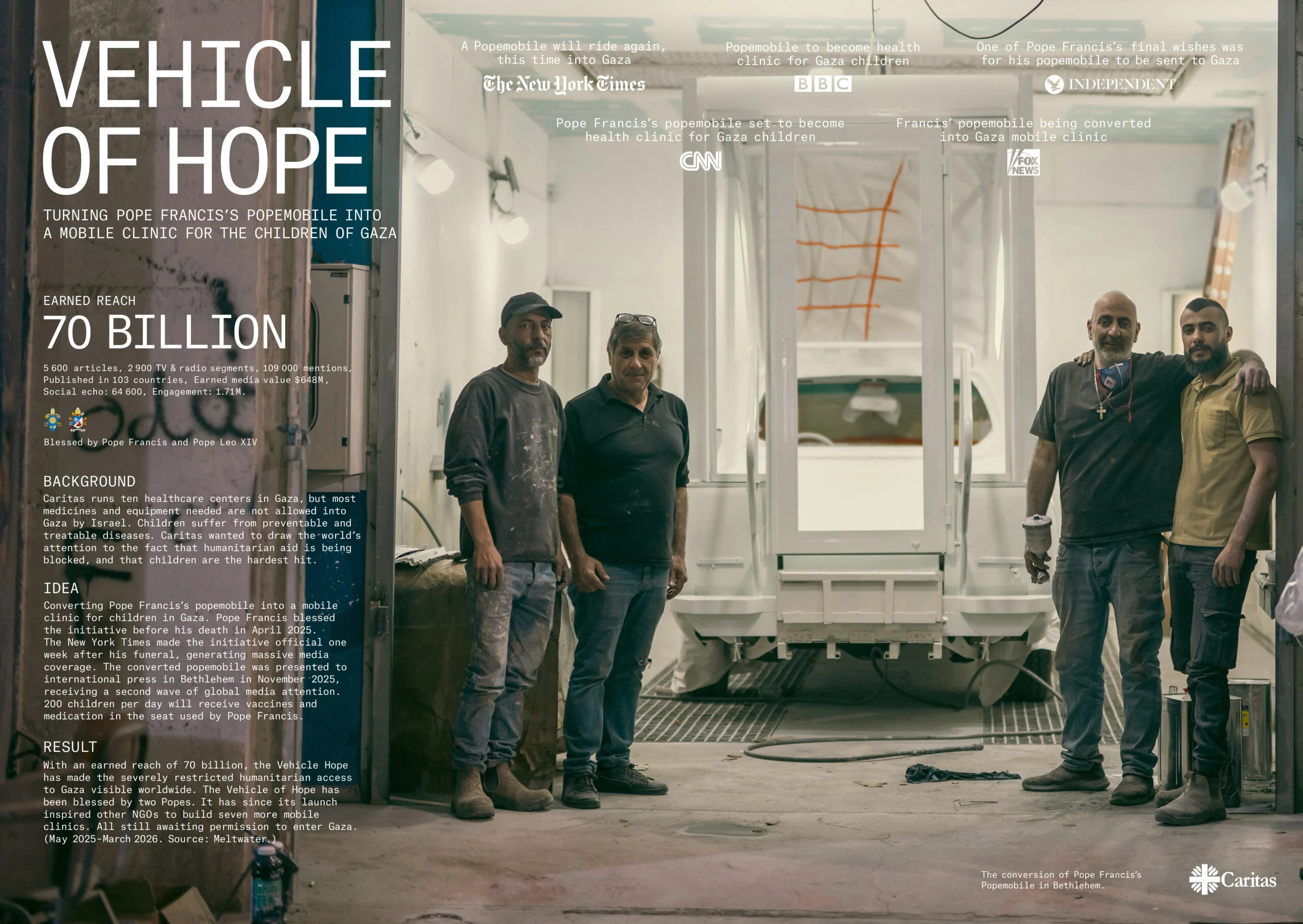
Can a papal icon break through global crisis fatigue? This Caritas – Vehicle of Hope (Case Study) explores how transforming Pope Francis’s Popemobile into a mobile pediatric clinic for Gaza sparked a diplomatic dialogue, generated 70B in earned reach, and unlocked $648M in media value.
Background
Amidst the prolonged humanitarian crisis in Gaza, the international relief network Caritas – specifically steered on the ground by Caritas Jerusalem alongside Caritas Sweden – maintains ten essential healthcare clinics staffed by 126 dedicated local medical and aid professionals. However, severe border restrictions imposed by the Israeli government have heavily curtailed the entry of vital humanitarian and medical supplies into the territory.
As a direct result of this supply blockade, nearly one million displaced children across Gaza have been left vulnerable to preventable and easily treatable illnesses, ranging from severe infections to acute malnutrition. Despite children’s fundamental dignity and right to healthcare being explicitly enshrined in the UN Convention on the Rights of the Child, access to basic life-saving treatment remained critically obstructed. Facing mounting global media fatigue, Caritas needed a bold, high-impact communications intervention to spotlight the blockade of medical relief and pressure authorities to open humanitarian corridors for Gaza’s youngest victims.
Creative Idea
To cut through geopolitical polarization and global apathy, Caritas conceived the Vehicle of Hope: transforming an iconic symbol of global peace – Pope Francis’s own Popemobile – into a fully equipped, life-saving mobile pediatric clinic for the children of Gaza.
Rather than relying on traditional charity appeals, the Caritas Vehicle of Hope campaign turned a historic papal vehicle into both a functional medical unit and an undeniable diplomatic statement. If a mobile clinic personally donated and blessed by the Pope as his final gift to the children of Gaza was barred from entering the territory, the restriction itself would become the ultimate global news story – forcing the blockade of humanitarian aid back onto the front pages of the world’s press.
Strategy
The strategic architecture behind the Caritas – Vehicle of Hope (Case Study) rested on three core pillars: moral authority, newsjacking precision, and two-phase earned media amplification.
- Leveraging Unmatched Moral Authority: In November 2024, Cardinal Anders Arborelius of Sweden presented the proposal directly to Pope Francis at the Vatican. In the final months of his life, Pope Francis wholeheartedly endorsed and blessed the initiative, entrusting Caritas to turn his vehicle of representation into an instrument of concrete pediatric care.
- Agile PR Timing Around the Papal Conclave: The campaign team tracked down the specific Mitsubishi L200 Popemobile originally gifted by Palestinian Authority President Mahmoud Abbas and used by Pope Francis during his historic 2014 pilgrimage to Bethlehem in the West Bank. However, while the vehicle was still undergoing medical retrofitting, Pope Francis passed away in April 2025. Recognizing the uncertainty of whether the incoming pontiff would publicly champion the project – and understanding that global attention on the Vatican was at an all-time high – the team strategically pitched the exclusive story to The New York Times ahead of the papal conclave.
- Sustaining Momentum from Announcement to Reality: By splitting the PR rollout into two distinct peaks – first revealing the late Pope’s final humanitarian wish in May 2025, and later unveiling the completed medical vehicle in November 2025 – Caritas turned a single charitable initiative into an ongoing international diplomatic narrative.
Execution
Phase 1: The Global Reveal (May 2025)
Exactly one week after Pope Francis’s funeral, on May 4, 2025, The New York Times broke the story of the Pope’s final wish to convert his Popemobile into a health clinic for Gaza’s children. Positioned right before the conclave, the story captured immediate worldwide attention, reframing the Gaza aid blockade through the lens of human dignity and papal legacy.
Phase 2: Engineering the Mobile Pediatric Unit
Working alongside specialized mechanics and medical engineers in the region, Caritas stripped and reinforced the 2014 Popemobile to withstand harsh field conditions, including Fitting protective blast-resistant window shielding. The open rear platform where the Pontiff once stood was enclosed and outfitted with state-of-the-art pediatric equipment: rapid diagnostic tests for infections, vaccines, suture kits, syringes, oxygen supplies, vital-sign monitors, and solar-powered refrigeration for life-saving medicines. Staffed by a dedicated team of doctors and paramedics, the completed Vehicle of Hope was engineered to examine and treat up to 200 children per day.
Phase 3: The Bethlehem Unveiling & Diplomatic Escalation (November 2025)
In November 2025, Caritas unveiled the fully converted Vehicle of Hope to international press in Bethlehem, steps away from the Church of the Nativity. Having subsequently received the blessing of a second Pontiff, the completed clinic generated a massive second wave of global media coverage. High-profile outlets – including The Washington Post and The Jerusalem Post – directly contacted the President of Israel for official comment regarding the fulfillment of the Pope’s humanitarian wish, elevating a charity campaign into high-level diplomatic discourse.
Results
The Caritas – Vehicle of Hope initiative became one of the most talked-about humanitarian advocacy campaigns in modern history, reminding audiences across 203 countries that every child has an inalienable right to medical care, regardless of faith or geography.
Earned Media & Global Reach
- 70 billion in total earned media reach worldwide.
- $648 million in Earned Media Value (EMV) – achieved with zero paid media spend.
- 5,600+ print and digital press articles published across 203 countries and territories.
- 2,900+ international TV and radio broadcast segments.
- 109,000 total mentions and 64,600 social echo shares, driving 1.71 million active engagements across digital platforms.
Humanitarian & Diplomatic Ripple Effect
- Catalyzing an NGO Fleet: Inspired directly by the Caritas Vehicle of Hope, partner NGOs and humanitarian organizations mobilized to build seven additional mobile medical clinics, creating an entire fleet of pediatric units ready to deploy into Gaza once border clearance is granted.
- High-Level Diplomatic Dialogue: The campaign pushed the issue of pediatric medical access into top-tier geopolitical negotiations, initiating active, ongoing dialogues with members of the Trump administration’s Board of Peace to secure safe passage into Gaza.
- Immediate Field Readiness: Capable of treating 200 children daily (over 1,400 pediatric patients per week), the Vehicle of Hope stands ready at the threshold of Gaza – serving as both a tangible medical lifeline and a relentless moral reminder to the international community.
Case Film
Credits
- Client: Caritas Sweden
- Advertising Agency: Differ; Forever Sustainable
- Production Company: Colony
- Photography: Raw Media Production


