
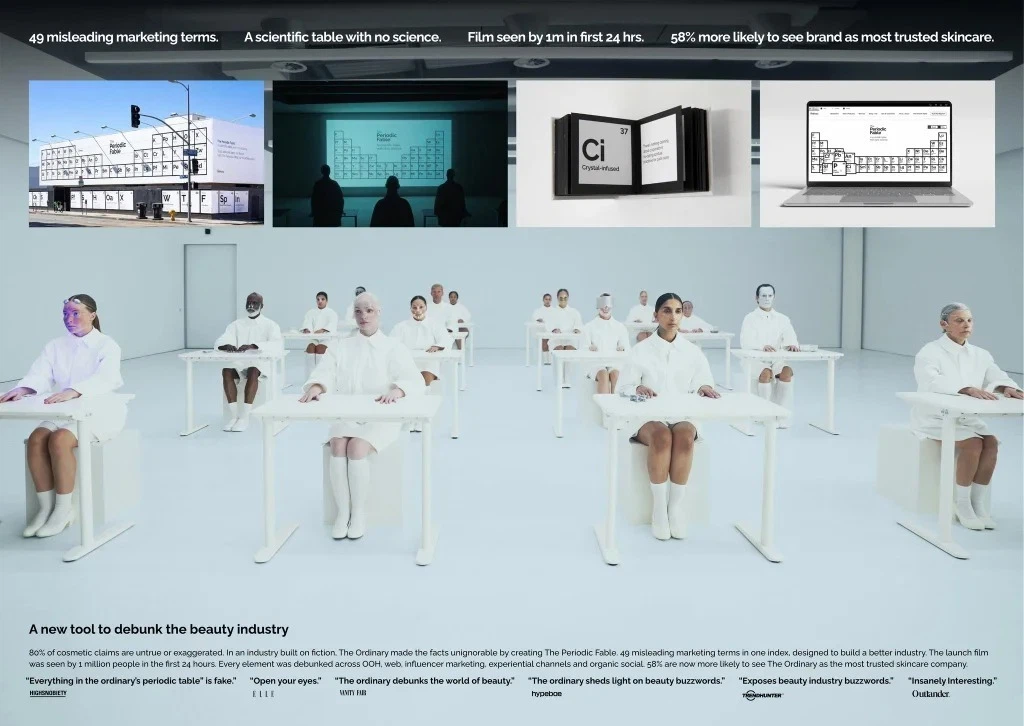
How do you sell scientific truth in a beauty industry addicted to marketing fiction? This The Ordinary – The Periodic Fable (Case Study) unpacks how the brand and Uncommon Creative Studio exposed 49 meaningless skincare buzzwords – driving an 11.8x surge in web traffic and a 4.6x lift in engagement.
Background
Since its inception under the DECIEM umbrella, The Ordinary has disrupted the global beauty landscape through radical transparency – championing single-ingredient clarity, accessible clinical pricing, and honest, science-backed formulations.
Yet the brand operates inside an industry historically built on smoke, mirrors, and linguistic exaggeration. Across retail aisles and social feeds, the modern skincare market is flooded with unregulated marketing jargon – from “medical grade” and “clean beauty” to “stem cells” and “eternal youth.” Engineered to project false clinical authority, scarcity, or miraculous transformation, these hollow buzzwords exist for one primary commercial reason: to justify inflated price tags and fuel hyper-consumption, particularly among Gen Z and young millennial shoppers caught in algorithmic TikTok skincare loops.
What appears on the surface as harmless creative puffery is, in reality, a systemic consumer tax. Shoppers are routinely conditioned to overpay for products disguised as luxurious, rare, or revolutionary despite having zero regulated scientific standing. Against the backdrop of a global cost-of-living crisis, exploiting consumer confusion carries real financial weight.
Tasked with cutting through this noise alongside creative partner Uncommon Creative Studio, The Ordinary refused to shout louder or invent competing hyperbolic claims. Instead, the brief was to make radical honesty culturally unavoidable – answering the ultimate strategic challenge: how do you champion truth in a category addicted to fiction?
Creative Idea
Collaborating directly with in-house cosmetic chemists and independent scientists, The Ordinary audited the beauty industry’s vocabulary and isolated 49 pervasive marketing buzzwords that possess zero standardized scientific or regulatory meaning – terms that sound clinical, aspirational, or authoritative, yet ultimately say nothing.
Rather than burying these findings in a white paper, the brand organized all 49 terms into The Periodic Fable™: a subversive reimagining of Mendeleev’s Periodic Table of Elements where chemical symbols like Hydrogen and Helium are replaced by beauty myths such as “Magic” (Mg), “Medical Grade” (Md), “Clean” (Cl), “Poreless” (Pl), and “Fat Freezing” (Ff).
Designed not merely as a fleeting ad campaign but as a permanent, open-source index for industry accountability, the interactive table lives on TheOrdinary.com as a public educational utility – where clicking any “element” unlocks digestible, chemist-verified explanations dismantling the deception behind the claim.
To force a public reckoning, the system expanded into monumental out-of-home (OOH) murals and stark typographic posters across major global capitals, transforming city streets into open-air classrooms. Anchoring the ecosystem was a haunting, dystopian hero film depicting a classroom of students mechanically reciting the 49 buzzwords while performing synchronized, viral TikTok skincare routines – hypnotized by algorithmic misinformation until one student finally breaks the spell. In a market that has miseducated consumers for decades, The Ordinary The Periodic Fable set out to rewrite the curriculum.
Insights & Strategy
The strategic foundation of The Ordinary – The Periodic Fable (Case Study) rested on a sharp behavioral truth: beauty marketing works because it sounds like science – even when it is pure fiction.
Research into consumer psychology revealed how easily linguistic framing manipulates price perception. Shoppers instinctively equate complex pseudo-scientific jargon with clinical efficacy, and luxury labeling with product legitimacy. Over 50% of UK beauty buyers admit they are more inclined to trust a product labeled “luxury,” while US consumers willingly pay steep premiums for formulas boasting “rare ingredients.”
However, macroeconomic and cultural tides were turning. Squeezed by inflation and growing increasingly fatigued by paid influencer hype, consumers were actively craving accountability. While The Ordinary would never stoop to deceptive copywriting, staying silent meant allowing the category status quo to go unchallenged.
The strategy weaponized scientific structure as both a spotlight and a shield:
- Deconstructing the Playbook Instead of Making Counter-Claims: Rather than running defensive ads claiming The Ordinary’s serums were better, the campaign exposed the linguistic machinery of the entire beauty industry – turning marketing literacy into a tool of consumer empowerment.
- Twofold Brand & Category Ambition: First, cement The Ordinary’s distinctive position as the undisputed authority in transparent skincare. Second, elevate ingredient and claim transparency from a single brand’s positioning into a non-negotiable consumer expectation across the entire category.
Execution
Every craft decision across the campaign adhered to The Ordinary’s signature aesthetic: clinical restraint, monochromatic minimalism, and zero decorative fluff.
- The Dystopian Launch Film: Directed by Olivia De Camps, the hero film unfolds inside an eerie, brutalist lecture hall. Dressed in uniform silhouettes, rows of students chant the 49 elements of The Periodic Fable in hypnotic unison while executing robotic, synchronized physical gestures that mirror viral social media beauty trends – from aggressive ice rolling and lymphatic guasha sculpting to peeling off a “morning shed” of overnight masks. Stripped of warm beauty lighting, the cold, rhythmic pacing mirrors the algorithmic echo chambers driving modern overconsumption.
- Typographic OOH & Urban Classrooms: Across high-footfall OOH sites and giant street murals in key global markets (including London and New York), individual buzzwords were isolated inside stark black-and-white chemical element boxes, while full-scale murals displayed the complete 49-element chart – turning urban walls into public curricula.
- The Interactive Digital Index & Tactile Press Kits: Hosted permanently on TheOrdinary.com, the digital Periodic Fable™ lets consumers, beauty critics, and creators explore the scientific breakdown behind every single term. To bring the curriculum into physical spaces, The Ordinary distributed bespoke academic press and creator kits containing large-format wall posters and hardbound reference manuals engineered for studio desks and classrooms.
In a category defined by glossy retouching and overblown promises, clinical clarity became the loudest statement in the room.
Results
The Ordinary – The Periodic Fable (Case Study) ignited an immediate worldwide conversation, proving that intellectual honesty and industry disruption can simultaneously drive viral engagement and commercial conversion:
Digital, Social & Traffic Surge
- 11.8x surge in website traffic to TheOrdinary.com as users flocked to explore the interactive Periodic Fable index.
- 4.6x increase in social engagement across brand channels, with millions of video views logged within the first 24 hours of launch.
- 5x increase in new follower growth.
- 4x increase in total brand impressions.
Earned Media & Creator Amplification
- Sparked organic cultural traction across 24+ countries, generating 80+ tier-one editorial press features spanning mainstream news, business, and beauty publications.
- Inspired hundreds of organic creator reaction videos, with dermatologists, cosmetic chemists, and skincare influencers dissecting the 49 elements for their own audiences.
Commercial & Brand Equity Lift
- Among American women – a primary growth demographic for the brand – the campaign delivered a +10.4% lift in purchase intent alongside an +8.5% increase in brand awareness, cementing The Ordinary as the definitive voice of truth in modern beauty.
Case Film
Credits
- Client: DECIEM
- Brand: The Ordinary
- Advertising Agency: Uncommon Creative Studio London
- Production Company: Smuggler London
- Sound Production: IXYXI
- Media Agency: Quan Media
- Colour Grading: Studio RM


